What is a carbon handprint?
A carbon handprint describes the positive climate impact that any organization can create by offering solutions that help others reduce their greenhouse gas emissions. This applies to companies, cities, universities, public authorities and NGOs and many other actors that provide solutions that help others reduce their greenhouse gas emissions.
These solutions may include technologies, services, policies, infrastructure, educational programs, or operational models that enable users, customers, residents, or partners to lower their own carbon footprints.
Unlike the traditional footprint approach, which focuses on environmental burdens, the carbon handprint highlights the positive life‑cycle impact of a solution compared to a alternative baseline solution.
The core idea is:
- A carbon handprint grows only when an organization’s actions reduce someone else’s emissions.
- Reducing the organization’s own emissions improves its carbon footprint, but does not increase its carbon handprint.
Benefits of using a carbon handprint for an organization
Carbon handprint shifts the climate conversation toward opportunities: by systematically increasing their handprint, companies can maximize the climate benefits of their products and services, while cities that grow their handprint become more attractive locations for green business and investment.
The carbon handprint approach supports innovation by directing resources toward climate‑friendly solutions and investments. It helps companies focus product development on solutions that reduce their customers’ carbon footprints, which in turn helps drive business renewal.
The approach provides fact‑based information on the positive climate impacts of solutions. This enables clearer communication with customers, the public and investors, and strengthens decision‑making by offering insights into markets and competitors.
Although still underused, the carbon handprint concept holds significant potential both locally and globally, and many CLC member organizations are already integrating the methodology into their operations.
Ways for organizations to increase their carbon handprint
Organizations can increase their carbon handprint by developing and offering solutions that reduce the carbon footprint of others more effectively than the current baseline. This typically begins with identifying where customers or users generate the most significant emissions and designing products, services or operational models that directly address these high-impact emission sources.
Clients' emissions can be reduced by:
1. Improving energy and material efficiency
- Companies can support their customers by offering digital optimization tools, automation solutions or data‑driven services that improve operational efficiency, reduce resource use or optimize logistics, thereby reducing emissions indirectly but measurably.
2. Replacing high-carbon inputs with low-carbon or renewable alternatives
- Replacing emissions‑intensive processes or materials with innovative low‑carbon technologies such as bio‑based materials, electrified processes, renewable energy solutions or lightweighting technologies can substantially increase the carbon handprint, especially in energy‑intensive industries.
3. Reducing waste, extending product lifetimes, and enabling reuse.
Carbon capture and storage (CCS) is also becoming increasingly relevant contributor, especially when it enables customers to avoid process emissions that cannot otherwise be eliminated.
Cities and regions can increase their carbon handprint by enabling sustainable mobility, low-carbon energy systems or circular economy services.
By systematically integrating handprint thinking into R&D programs, product development and customer collaboration, organizations can ensure that climate benefits are maximized across the entire value chain and that new innovations are intentionally designed to produce scalable positive impacts.
Calculation methodology
The carbon handprint quantification methodology was developed by LUT University and VTT Technical Research Centre of Finland and presented in the Carbon Handprint Guide V. 2.0.
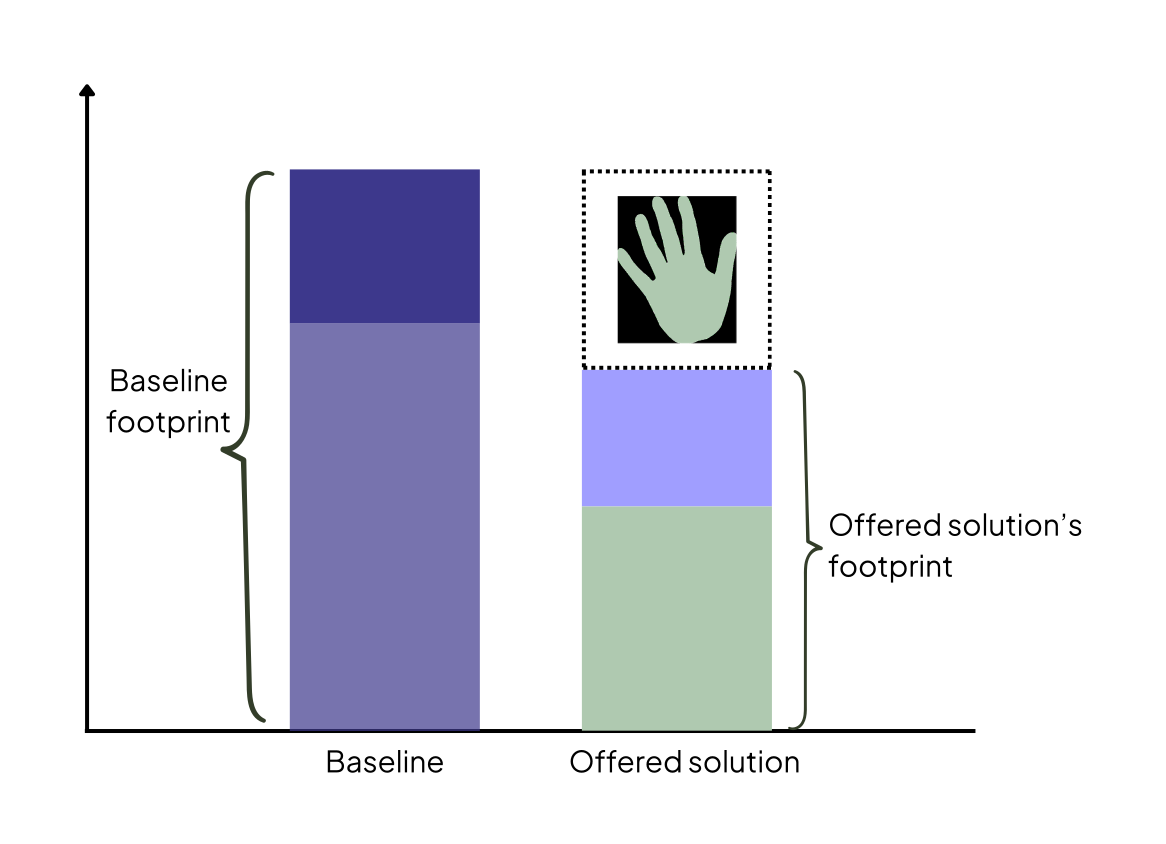
In practice, carbon handprint is calculated by comparing two carbon footprints:
- Baseline carbon footprint: the emissions of the conventional or commonly used solution
- The handprint solution’s carbon footprint: the emissions of the improved, lower‑emission solution.
Carbon handprint = baseline carbon footprint − handprint solution carbon footprint.
To ensure comparability, both footprints must be calculated using the same system boundaries, functional unit and calculation rules. The calculation must be fully consistent with life cycle assessment (LCA) methodology and follow established LCA and carbon footprint standards, including:
- ISO 14067 – Carbon footprint of products
- ISO 14040 & ISO 14044 – General LCA principles and requirements
- Additional supporting standards may include ISO 14046 (water footprint) and ISO 14026 (environmental footprint communication)
More detailed information on the scientific calculation method cis provided in the Carbon Handprint Guide V. 2.0 by LUT University and VTT.
Another closely related method for assessing positive climate impacts is the avoided emissions methodology, developed under the World Business Council for Sustainable Development (WBCSD).
Communicating about a carbon handprint while avoiding greenwashing
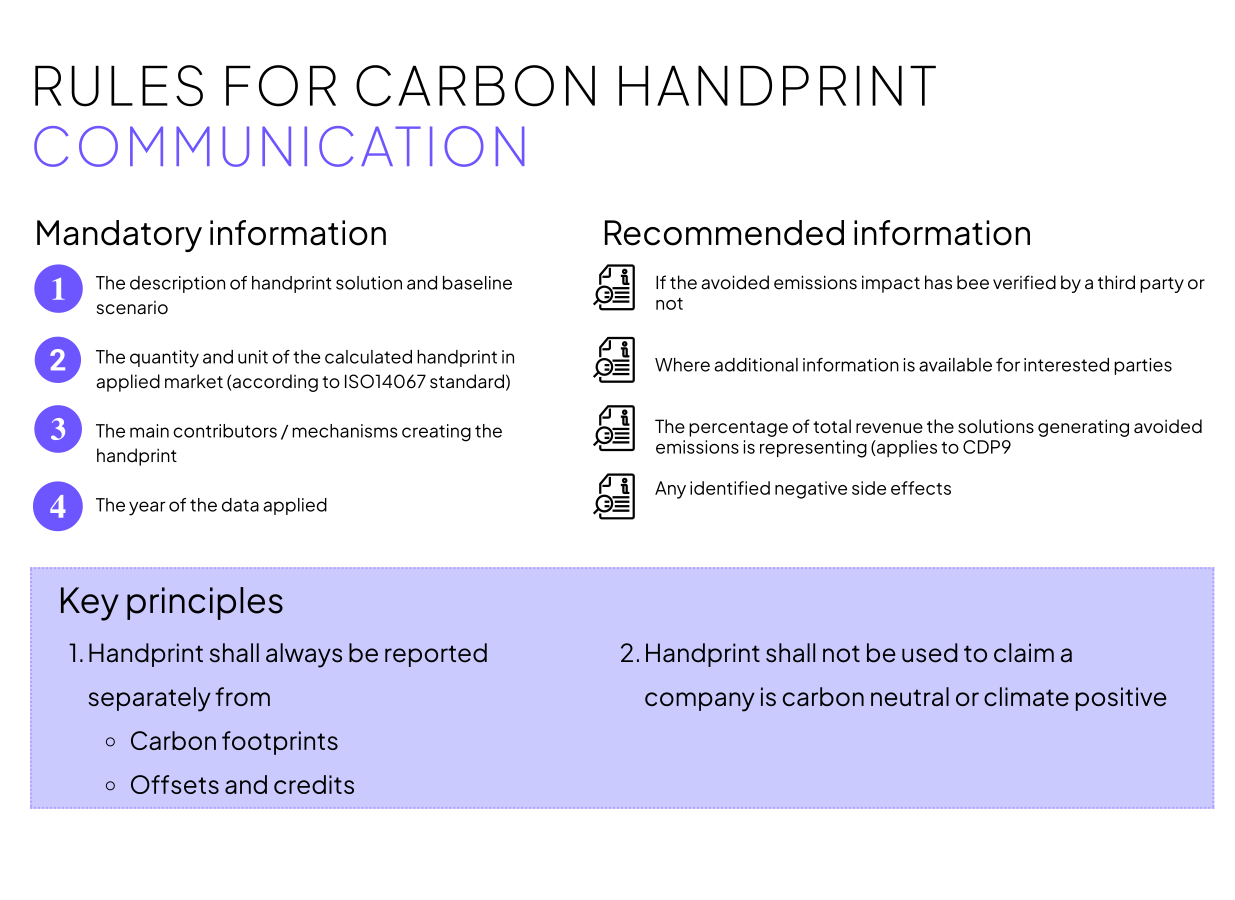
Credible communication about a carbon handprint begins with transparency. Claims must be based on measurable and standardized calculations that follow the established carbon handprint methodology. This includes defining the baseline clearly, explaining the assumptions behind the calculations and avoiding overstating impacts that cannot be classified as a carbon handprint.
It is important to note that the carbon handprint is a comparative claim. According to Directive (EU) 2024/825 on Empowering Consumers for the Green Transition, environmental claims — including claims that imply a comparison with other products or commonly used solutions — must be based on clear, objective, publicly available and verifiable evidence, in order to avoid misleading consumers.
When communicating about a carbon handprint, it must always be remembered that the carbon footprint and the carbon handprint cannot be added together – an organization cannot reduce its own carbon footprint by subtracting its carbon handprint from it.
Fact‑based communication, supported by comparable LCA‑based results, helps minimize the risk of greenwashing and enables stakeholders to understand the real climate benefits of the solution.
Development of the carbon handprint concept and calculation methodology
The handprint concept was first introduced in 2007 by UNESCO as a way to measure actions that reduce the human footprint through education for sustainable development. Later, in the early 2010s, Gregory A. Norris expanded and formalized the broader handprint idea by defining it as the positive environmental and social impacts individuals and organizations can create.
The quantitative approach to measuring positive climate impacts was developed in Finland between 2016 and 2018. LUT University and VTT created a science‑based calculation framework for the carbon handprint, and the first Carbon Handprint Guide was published in 2018 , marking the first structured and internationally usable methodology. A revised Carbon Handprint Guide V.2.0 followed in 2021.
Find the Carbon Handprint Guide V. 2.0 here.
In 2021, the approach broadened beyond companies: cities and public authorities began using the carbon handprint to quantify how municipal infrastructure, policies, and services help residents and businesses reduce their emissions.
In 2022, CLC launched the first International Carbon Handprint Award, highlighting solutions that create significant positive climate impacts. The first awards were granted to Schneider Electric and SSAB for solutions demonstrating exceptional ability to reduce their customers’ emissions - marking a milestone in global recognition of handprint-oriented innovation.
During 2022-2023 CLC, together with LUT University and VTT, worked to bring the carbon handprint methodology into international discussions.
CLC has published the following reports: