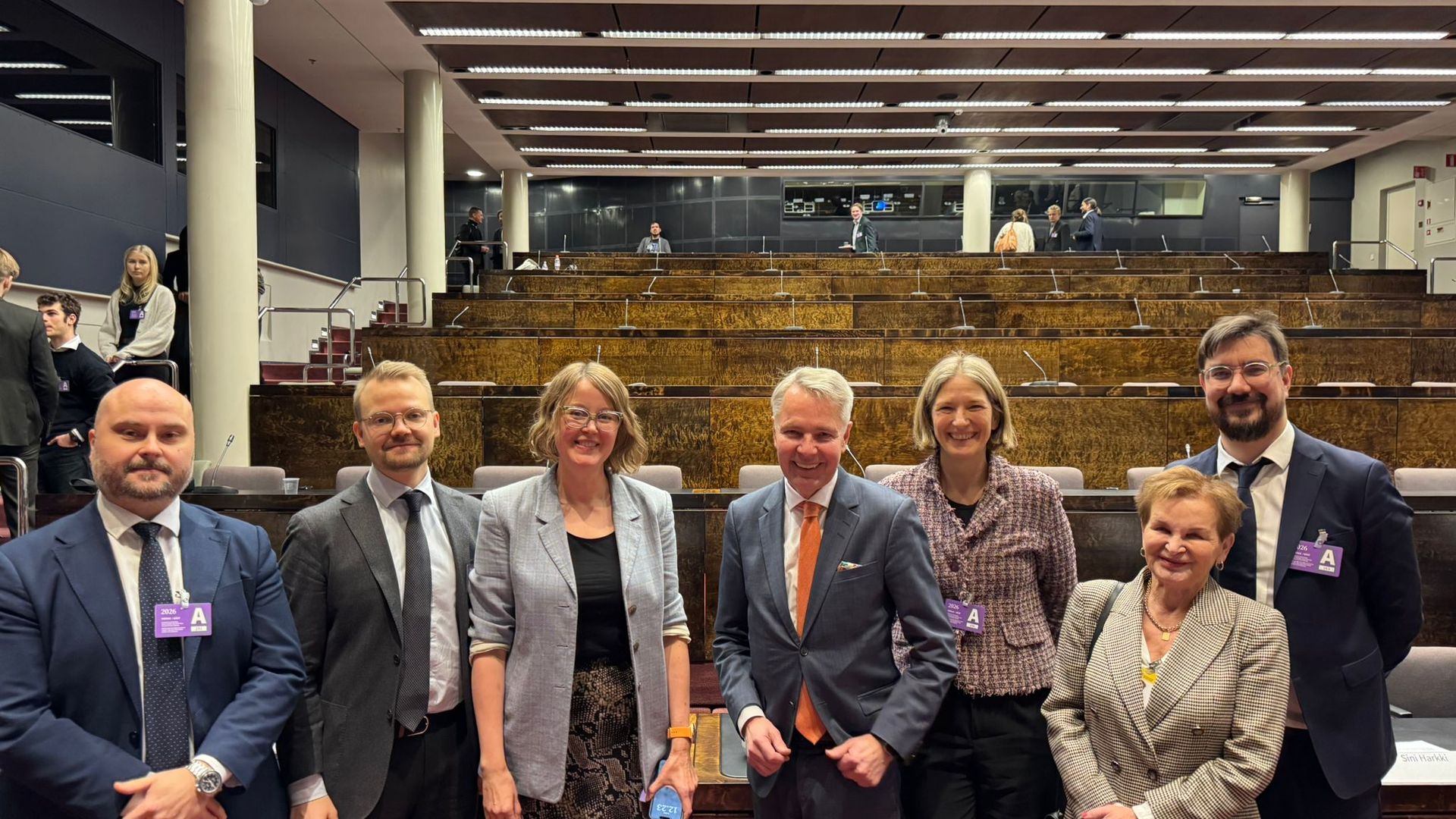
This week, CLC’s long-time individual member Member of Parliament Pekka Haavisto convened a seminar under the title Environment, Climate and the Transformation of the World Order. CLC was proud to support organizing the event and help bring together the exceptional group of speakers and discussants for a timely exchange of views.
In his opening remarks, Pekka Haavisto set the scene by describing the moment we are living in: a period of geopolitical turbulence and power political realignment, characterized by overlapping crises and growing fragmentation of the global system. States are increasingly diverging into industrial-strategic economies, fossil-fuel-based economies, and developing economies which have significant implications for climate diplomacy and the green transition. To understand the possible future trajectories emerging from this landscape, open dialogue between the private sector, policymakers, and civil society is essential, precisely the purpose for which this seminar was convened.
Predictability under strain from accelerating crises and approaching tipping points
A recurring theme throughout the discussion was that lack of predictability remains a challenge for necessary clean investments. Overlapping crises in security, the economy, climate, and global governance are accelerating, while political decision-making threatens to become more reactive and fragmented. At the same time, scientific evidence points to the increasing risk of climatic and ecological tipping points that carry potentially irreversible consequences. Together, these environmental and political dynamics are eroding the stable operating environment on which private investment depends.
Participants stressed that uncertainty about exact impacts or timelines is not a justification for inaction. On the contrary, growing uncertainty should sharpen risk awareness and reinforce the need for robust, forward-looking frameworks. In this context, predictable rules, credible long-term targets, and market-based mechanisms were repeatedly highlighted as essential tools for maintaining direction and enabling action, even as the surrounding environment becomes more volatile.
From multilateralism to coalitions and deals
One overarching theme in the seminar was the changing role of traditional multilateral cooperation. Multilateral climate agreements are increasingly supplemented or replaced by coalitions, bilateral deals, and issue-specific partnerships.
Opportunities and priorities for partnerships are also changing. Recent developments in the United States illustrate this volatility. While the country has been on a declining trajectory in climate leadership for some time, signals emerging in 2025 point to rising emissions and thereby heightened unpredictability. Competing domestic narratives in the US ranging from energy abundance and geopolitical competition to selective clean energy investment createsuncertainty for global markets.
China, meanwhile, has become a central force in the clean energy transition. China has emerged as a dominant exporter of clean technologies, driving prices down globally through scale and industrial learning. Its rapid expansion of clean energy capacity has recently stabilized domestic emissions growth. The key open question is whether China’s transition will pull others along and whether meaningful cooperation remains possible.
Nordic businesses must adapt to the political environment where they increasingly have to make deals with, not only each other, but also governments and diverse coalitions willing to advance the green transition. The role of climate and industrial diplomacy is on the rise and this offers both challenges and opportunities for companies. Global partnerships beyond Europe are also significant as European solutions can offer alternatives to developing counties' dependency on China and partnerships with countries like Turkey, India and Brazil can open new opportunities for climate smart solutions.
Uniting forces to defend the EU ETS
A central question running through the seminar was how to defend the EU Emissions Trading System (ETS) against increasingly vocal calls to halt or weaken its development. There was broad consensus among the discussants that the ETS forms the backbone of a predictable, market-based climate policy, one that is essential for enabling the large-scale investments required for the green transition.
Speakers emphasized that deeper regulation and subsidy-driven approaches are not effective substitutes for the ETS. Fragmented support schemes fail to provide the long-term clarity and predictability that investors need. In a landscape of subsidy competition, smaller countries such as Finland are at a clear disadvantage. It is therefore firmly in the interest of Finnish and Nordic companies to amplify their voices in support of the EU ETS, both domestically and internationally.
One of the conclusions of the seminar was that businesses play a critical role in defending carbon pricing. Business engagement was recognizedas a decisive factor in achieving past EU emissions reductions. With the ETS now under renewed pressure, companies need to speak clearly and publicly in its support and to demonstrate how ETS-driven climate policy translates into concrete economic, industrial, and societal benefits.