For over 20 years, the European carbon pricing mechanism, the EU Emissions Trading System (EU ETS), has been built as the cornerstone of EU climate policy. It has boosted investments in clean solutions and created a forward price for carbon.
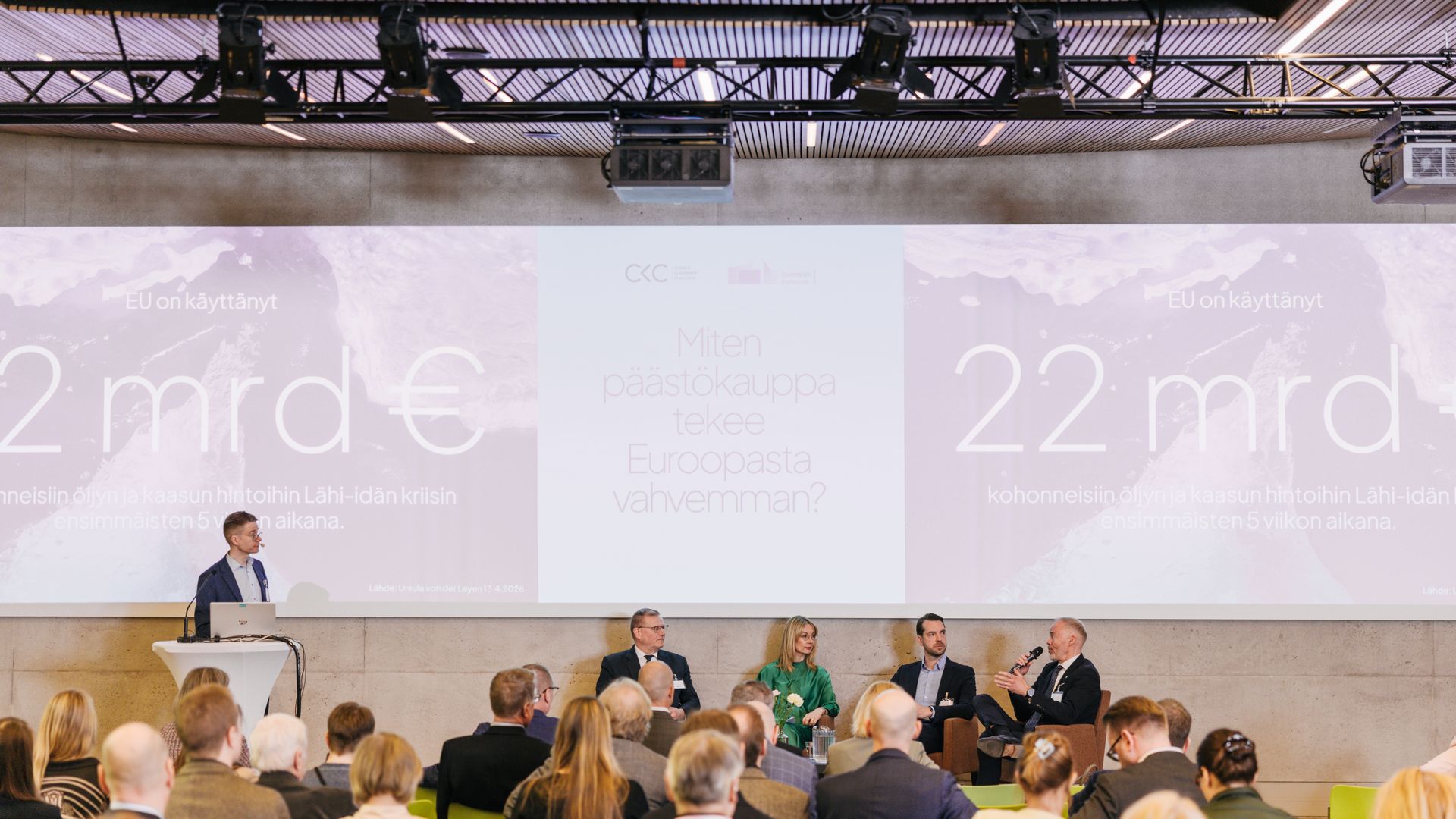
That is why, on 21 April 2026, Climate Leadership Coalition and the European Commission Representation in Finland convened a high-level seminar in Helsinki to discuss how the EU ETS contributes to European competitiveness, resilience, and strategic autonomy.
The event was held at Paasitorni and streamed live, bringing together more than 300 decision-makers from industry, public administration, academia and politics.
The discussions highlighted that emissions trading has been a central factor in Europe’s ability to cut emissions while growing the economy. Since the launch of the EU ETS in 2005, emissions covered by the system have declined by more than half, while economic growth has continued. Participants underlined that this long-term decoupling of economic growth from emissions is critical for Europe’s industrial future.
Predictable carbon pricing as a foundation for investment
A key theme throughout the seminar was the importance of a predictable and ambitious carbon price extending into the 2030s.
Damien Meadows from the European Commission noted that the ETS has proven both robust and adaptable over time. He stressed that the system should be strengthened rather than weakened, particularly in the context of geopolitical instability and volatile fossil fuel markets. Emissions trading was repeatedly described as the most efficient market-based instrument for directing capital toward low carbon solutions, but also as a functioning carbon market was described as a core pillar of Europe’s energy security.
Industry perspectives from Finland
Chief executives shared concrete experiences of how emissions trading has shaped investment decisions in Finnish industry. Kati ter Horst, CEO of Outokumpu, and Olli Sirkka, CEO of Helen, highlighted that a clear and predictable carbon price has supported long‑term planning, electrification, and the phase‑out of coal. The speakers noted that many of the most impactful decarbonisation decisions have ultimately been commercially driven, with the EU ETS acting as a critical incentive.
The discussion also addressed competitiveness concerns. Industry representatives stressed that early investments in low carbon solutions should be rewarded, not penalised, as the regulatory framework evolves. The need for alignment between climate policy and industrial policy was repeatedly highlighted.

Policy coherence and European leadership
Permanent Secretary of the Ministry of the Environment Juhani Damski and Director of the Energy Department at the Ministry of Economic Affairs, Riku Huttunen, underlined that emissions trading is not only a climate instrument but also a strategic economic tool. Both noted that the EU ETS is central to reducing dependence on fossil fuel imports, strengthening resilience, and supporting Europe’s position in global clean technology markets.
Several interventions focused on the importance of coherence and predictability in policy making, particularly as the EU prepares decisions related to the 2040 climate target. Panelists emphasized that uncertainty and short-term deviations risk delaying investments that are needed now.

Looking ahead
Across the panels, there was broad consensus that the EU ETS should remain in the backbone of European climate policy. Rather than questioning the system, the focus should be on how it can be further developed to support industrial renewal, innovation, and a just transition across all sectors of the economy.
The seminar concluded that emissions trading is a key driver for competitiveness and competitive advantage for Europe and for Nordics in particular. Maintaining a strong and credible ETS was seen as essential for securing long-term growth, jobs, and resilience in an increasingly competitive global environment.