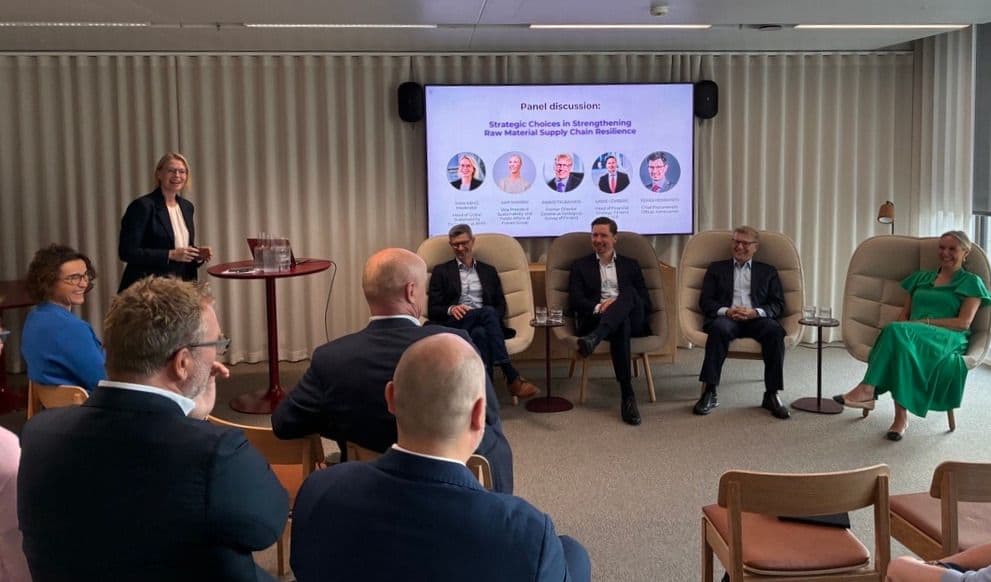
Geopolitical uncertainty, climate disruption and growing dependencies are forcing companies to rethink how they build resilience. On 3 September, CLC, Combient and AFRY brought together business leaders and experts for a closed-door breakfast discussion in Helsinki on how companies can strengthen raw material supply chain resilience while maintaining competitiveness in an increasingly volatile operating environment.
The event featured Jukka Siukosaari, SVP Public Affairs and Geopolitics at Neste; Christine George, EVP Strategy at Konecranes; and a panel moderated by Tiina Kähö, Head of Global Sustainability Consulting at AFRY, with Kati Ihamäki, Vice President Sustainability and Public Affairs at Fiskars Group; Kimmo Tiilikainen, former Director General at the Geological Survey of Finland; Lasse Lemberg, Head of Financial Strategy, Finland at SEB; and Pekka Honkanen, Chief Procurement Officer at Konecranes.
A clear message emerged from the discussion: resilience is not simply about reacting well when disruption occurs. It needs to be built into the business before it is needed.
Geopolitical risk requires organisational capability
Geopolitical developments are difficult to predict, and trying to forecast them with ever more detailed analysis is unlikely to provide certainty. Instead, companies need to develop the ability to understand how external developments could affect their business and prepare for different scenarios.
This requires bringing geopolitical awareness into the wider organisation, rather than treating it as the responsibility of a small group of experts. Employees across the organisation can contribute valuable knowledge about markets, customers and local developments. The challenge is to create the structures and culture that allow this knowledge to inform decision-making.
The objective is not to predict the future, but to be prepared to change course quickly when circumstances change.
Resilience needs to be built before disruption hits
Resilience is often associated with crisis response. But the discussion highlighted the importance of building resilience proactively – into supply chains, operations and, ultimately, the business model.
This means making strategic choices that remain viable across different possible futures. Optionality becomes a competitive advantage: multiple suppliers, technology pathways, geographical options and growth engines can give companies greater room to manoeuvre when conditions change.
At the same time, resilience requires choices about where to build redundancy and where to accept dependencies. Not every risk can or should be eliminated. The key is understanding which dependencies could constrain growth, customer reliability or strategic freedom, and focusing resilience efforts where they matter most.
Raw materials are a strategic issue
Finnish and European industry remains highly dependent on external sources of raw materials, while geopolitical uncertainty and a changing climate are creating new risks for global supply chains. The assumption that global, just-in-time supply chains will always function smoothly is coming under increasing strain.
For industrial companies in particular, critical raw materials and components need to be considered as part of strategic planning, not only as a procurement issue. Companies need a clearer understanding of where their most important dependencies lie, where alternatives exist and where supply chains could be redesigned.
This also raises a broader question: how can companies reduce one dependency without simply creating another? Diversification, regionalisation, alternative materials and technologies, and stronger circularity can all contribute, but each involves trade-offs around cost, scale, efficiency and competitiveness.
The discussion pointed towards a need to move beyond risk management towards a more strategic approach to raw material use and supply chains.
Circularity can strengthen resilience
Circularity is increasingly relevant not only from an environmental perspective, but also as a way to reduce strategic dependencies.
Recycling, refurbishment, product lifetime extension and redesign can reduce demand for vulnerable raw materials and create additional options within value chains. At the same time, these approaches need to make sense commercially and meet customer expectations.
Circular business models can address several emerging risks simultaneously while creating new business opportunities. Building these capabilities takes time, however, and cannot be done by individual companies alone. Collaboration across ecosystems – with suppliers, customers and other partners – is essential.
From reacting to creating strategic room to manoeuvre
The discussion ultimately pointed to a broader shift in how companies should think about resilience.Resilience is not about preparing for one particular future. It is about creating the strategic room to navigate many possible futures while maintaining the ability to create value.
In a world of geopolitical uncertainty, climate disruption and increasingly complex dependencies, resilience is therefore becoming not just a risk-management question, but a core strategic and competitiveness issue.
The companies best positioned for an uncertain future will not necessarily be those that can predict disruption most accurately, but those that have built enough optionality and strategic flexibility to adapt when it comes.


